When you are building a business, every dollar is a strategic asset. You likely have a list of priorities—product development, marketing, hiring—that all seem to demand immediate capital. Often, founders view a small business lawyer as a “break glass in case of emergency” resource rather than a foundational requirement.
However, the question isn’t just “What does a lawyer cost?” but “What does a mistake cost?” At Rock-Hurst Astor PLLC, we work with innovators and entrepreneurs who understand that a solid legal foundation isn’t an expense—it’s an investment in the company’s future valuation and security.
In this guide, we’ll break down the current 2026 market rates for legal services and help you determine when it’s time to bring a professional onto your team.
Part 1: How Much Does a Small Business Lawyer Cost?
Legal fees are no longer the “black box” they once were. Modern law firms, including ours, prioritize transparency and predictability to align with the fast-paced nature of tech and corporate growth.
1. Hourly Rates
Hourly billing remains the standard for complex, unpredictable work like multi-party negotiations or litigation.
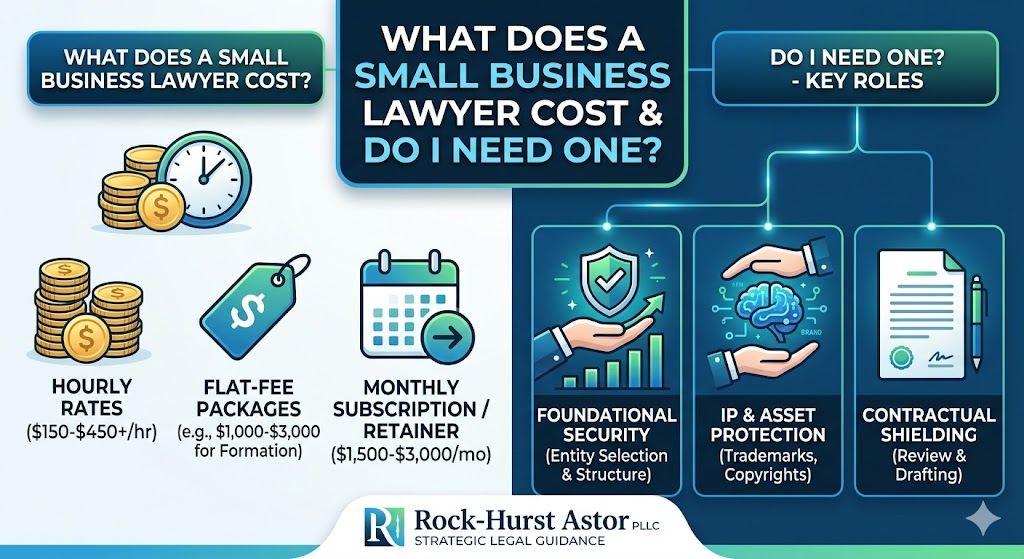
- National Average: In 2026, most small business lawyers charge between $150 and $450 per hour.
- Regional Factors: In major hubs like Washington, D.C., or New York City, rates for experienced technology and corporate counsel often range from $350 to $800+ per hour, reflecting the complexity of the regulatory environment.
- The “6-Minute Increment”: Most firms bill in tenths of an hour. A quick five-minute phone call might be billed as 0.1 hours.
2. Flat-Fee Packages
For standard, “predictable” tasks, many firms now offer flat fees. This is ideal for startups because it eliminates “sticker shock.”
- LLC/Corporate Formation: $1,000 – $3,000 (plus state filing fees).
- Simple Contract Review: $500 – $1,500 per document.
- Trademark Filing: $1,000 – $2,500 (plus USPTO fees).
- Employee Handbook/HR Suite: $1,500 – $4,000.
3. Subscription or “Outside General Counsel” Models
Many modern businesses prefer a monthly retainer. For a flat monthly fee (often starting around $1,500 – $3,000/month), you get a set number of hours or unlimited “quick questions.” This ensures you have an attorney who actually knows your business and can catch issues before they escalate.
Part 2: What Does a Small Business Lawyer Actually Do?
A lawyer’s job isn’t just to “sue people.” In fact, a good business lawyer’s primary goal is to prevent you from ever seeing the inside of a courtroom.
Entity Selection and Structural Integrity
Choosing between an LLC, an S-Corp, or a C-Corp isn’t just about taxes; it’s about future scalability. A lawyer ensures your Operating Agreement or Bylaws clearly define:
- Who owns what (Equity).
- How decisions are made (Governance).
- What happens if a partner wants to leave (Buy-Sell provisions).
Intellectual Property (IP) Protection
For many of our clients at Rock-Hurst Astor, their code, brand, or proprietary process is the business. A lawyer helps you:
- Register trademarks and copyrights.
- Draft IP Assignment Agreements to ensure that work created by contractors actually belongs to your company, not the individual.
Contractual Shielding
Contracts are the “rules of engagement” for your business. A lawyer drafts and reviews:
- SaaS and Licensing Agreements: Ensuring you aren’t giving away too much liability.
- Master Service Agreements (MSAs): Defining the scope of work and payment terms.
- Non-Disclosure Agreements (NDAs): Protecting your trade secrets during negotiations.
Employment and Compliance
Hiring your first employee is a legal milestone. You need to navigate:
- State-specific labor laws.
- Classification of employees vs. independent contractors.
- Non-compete and non-solicitation clauses.
Part 3: Do I Actually Need One?
Not every task requires a high-level attorney. Here is a simple framework to help you decide.
You probably DON’T need a lawyer for:
- Applying for an EIN: You can do this in minutes on the IRS website.
- Writing a Business Plan: This is a strategic document for you and your investors.
- Reserving a Business Name: Most state websites make this a simple, automated process.
You definitely SHOULD hire a lawyer for:
- Multi-Member Formations: If you have co-founders, you need a custom Operating Agreement. “Cookie-cutter” templates from the internet rarely cover the complexities of founder disputes or vesting schedules.
- Raising Capital: Whether it’s Venture Capital or Private Equity, the terms of your “Term Sheet” will affect you for years.
- Complex Tech Licensing: If your business involves SaaS, APIs, or cross-border data transfers (GDPR/CCPA), the regulatory risks are too high to DIY.
- Commercial Leases: These are notoriously one-sided in favor of the landlord. One bad clause can force you to pay for a building’s roof repair.
The Rock-Hurst Astor Difference: Practicality Over Pedantry
At Rock-Hurst Astor PLLC, we don’t believe in legal jargon for the sake of it. Our mission is to provide straightforward, budget-friendly, and strategic guidance.
We know that a startup in its “Seed” stage has different needs than a mid-cap company eyeing an M&A exit. Our team, led by experts like Richard Scully and Avra Kutcher, specializes in blending global legal expertise with the “down-to-earth” advice small businesses need to thrive.
The “Ounce of Prevention” Rule: Spending $2,000 on a solid contract today is significantly cheaper than spending $50,000 on a contract dispute two years from now.