

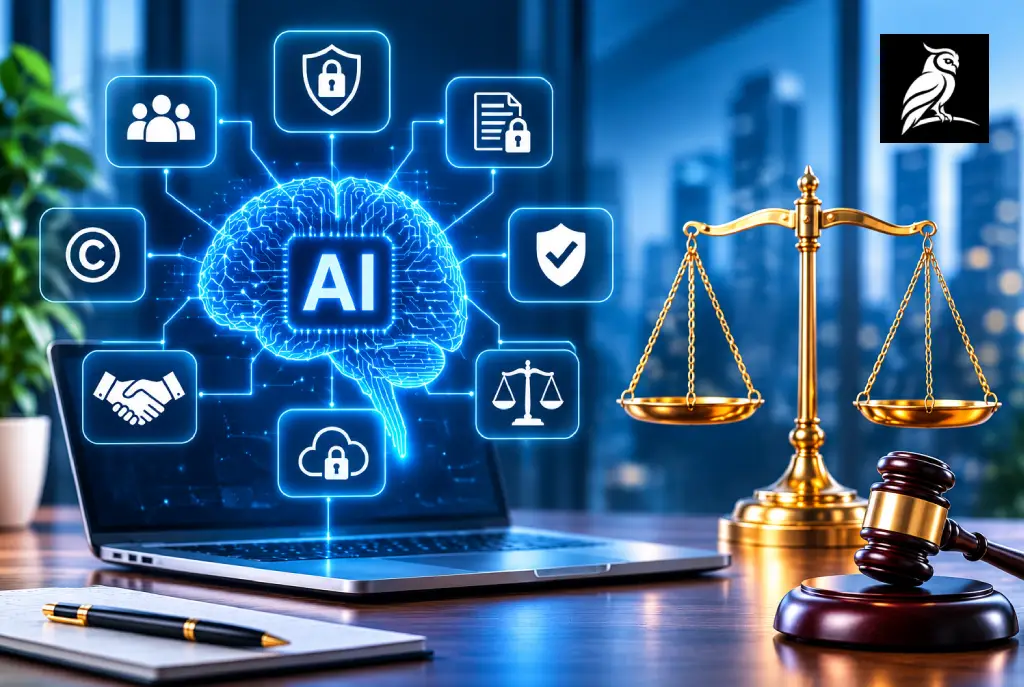
Generative artificial intelligence is transforming how businesses operate, compete, and serve customers. But as companies embrace these technologies, they are also assuming new legal, regulatory, contractual, and cybersecurity risks. Understanding those risks—and establishing appropriate safeguards—is becoming an essential responsibility of business leadership.
Introduction: The Business Opportunity Comes With Legal Responsibility
Artificial intelligence has moved rapidly from an emerging technology to an increasingly important component of everyday business operations. Generative AI tools can draft contracts, analyze financial information, prepare marketing materials, write computer code, summarize documents, support customer service, and assist executives with strategic decision-making.
For businesses seeking greater efficiency, lower operating costs, and a competitive advantage, the potential benefits are substantial.
However, the rapid adoption of these tools has created a new set of legal and corporate governance challenges. Employees may be sharing confidential company information with external AI platforms without authorization. Businesses may be relying on AI-generated content without understanding intellectual property ownership or infringement risks. Customer information and other personal data may be processed in ways that conflict with privacy obligations. Vendor agreements may fail to adequately address responsibility for data breaches, inaccurate outputs, or other AI-related losses.
These are not merely hypothetical concerns. They can expose businesses to litigation, regulatory scrutiny, contractual disputes, financial losses, and reputational damage.
Importantly, the legal risks do not arise only when a company develops its own AI technology. A business that simply uses a commercially available generative AI platform may still have significant legal responsibilities.
The central issue for business leaders is therefore not whether their organizations should adopt AI. In many industries, the competitive pressure to do so is already substantial. The more important question is whether the organization has the policies, contractual protections, and governance structures necessary to use AI responsibly.
For directors, executives, business owners, and general counsel, AI adoption should be treated as a corporate risk management issue—not simply an information technology decision.
This article examines six areas that deserve particular attention.
1. Employee Use of Generative AI: The Risks of Uncontrolled Adoption
One of the most immediate challenges facing businesses is the extent to which employees are already using generative AI tools.
Employees may independently use AI to draft correspondence, prepare presentations, summarize reports, analyze contracts, develop marketing materials, or generate software code. In many cases, they do so without first obtaining approval from management or understanding the implications of submitting company information to an external platform.
This creates what is commonly described as “shadow AI”: the use of artificial intelligence tools outside an organization’s approved technology, security, and governance framework.
A company may have comprehensive policies governing confidential information, cybersecurity, and employee conduct while having little visibility into how employees are actually using AI.
Consider a relatively straightforward example.
An employee preparing a business proposal uploads a draft agreement containing confidential customer pricing, financial projections, and proprietary commercial information into an online AI platform. The employee’s intention is simply to improve the document.
However, depending on the platform’s terms, settings, and data-handling practices, the information may be retained, processed, or used in ways that the company did not anticipate or authorize.
The employee may have inadvertently created a confidentiality, contractual, or data protection problem.
Why general technology policies may not be enough
Traditional acceptable-use and confidentiality policies do not always address the distinctive features of generative AI.
For example, employees need to understand:
- Which AI applications are approved for business use.
- Whether company information may be submitted to external AI platforms.
- What categories of confidential or sensitive information are prohibited.
- Whether AI-generated content may be used in customer communications or external publications.
- When human review and management approval are required.
- Whether AI may be used to analyze employee, customer, or other personal information.
- Who is responsible for verifying the accuracy of AI-generated work.
A blanket prohibition on AI use may appear to eliminate risk, but it can also discourage transparency and push employees toward unauthorized tools.
A more effective approach is to establish a clear, practical policy that distinguishes between permitted, restricted, and prohibited uses.
What an effective employee AI policy should include
Businesses should consider adopting a written AI acceptable-use policy addressing:
- Approved platforms and applications.
- Permitted business purposes.
- Restrictions on confidential information, trade secrets, personal data, and customer information.
- Requirements for human review and verification.
- Restrictions on using AI for employment, financial, legal, or other consequential decisions without appropriate authorization and oversight.
- Disclosure requirements where AI-generated content is used externally or where applicable law or contract requires disclosure.
- Employee training and accountability.
- Procedures for reporting suspected misuse, inaccurate outputs, or data exposure.
The policy should also address AI functionality embedded in existing software. Employees may be using AI without recognizing it—for example, through document management systems, customer relationship management platforms, productivity applications, and collaboration tools.
Ultimately, the organization should know which AI tools are being used, what information is being provided to them, and who is accountable for the resulting work product.
2. Confidentiality and Trade Secrets: Could AI Use Compromise Your Most Valuable Business Information?
For many companies, confidential information and trade secrets represent a substantial portion of their commercial value.
These may include:
- Customer and supplier databases.
- Pricing strategies and financial models.
- Business plans and acquisition strategies.
- Proprietary software and source code.
- Product designs and development plans.
- Manufacturing processes and technical specifications.
- Marketing strategies and confidential commercial agreements.
Businesses generally take considerable care to protect this information through nondisclosure agreements, employee confidentiality provisions, access restrictions, and cybersecurity controls.
However, the use of generative AI introduces an additional channel through which sensitive information can be disclosed.
When employees submit information to an AI platform, that information may be processed by an external service provider. The extent of retention, access, use, and deletion depends on the provider’s contractual terms, technical configuration, and applicable law.
A company should not assume that information remains confidential merely because it was submitted for an internal business purpose.
The trade secret issue
Under applicable trade secret laws, information generally must derive economic value from not being generally known or readily ascertainable, and its owner must take reasonable measures to maintain its secrecy.
This creates an important consideration for businesses using AI.
If an employee discloses proprietary information through an inadequately controlled external platform, the company may create questions about whether it has taken sufficient measures to protect the information.
Whether a particular disclosure compromises trade secret status depends on the facts, the platform’s practices, the contractual protections, and the circumstances of the disclosure. Nevertheless, the possibility deserves serious attention.
Practical protective measures
Businesses should:
- Prohibit employees from entering trade secrets or highly confidential information into unapproved AI systems.
- Review whether approved enterprise platforms provide appropriate data protection and retention controls.
- Examine whether submitted information may be used to train or improve vendor models.
- Restrict access to sensitive AI applications based on employee roles.
- Require appropriate confidentiality protections in vendor agreements.
- Train employees on the difference between public, internal, confidential, and highly restricted information.
- Establish procedures for responding to accidental disclosure.
Companies should also review their existing nondisclosure agreements and confidentiality provisions to determine whether they adequately address disclosures involving AI tools.
The objective is to ensure that the adoption of a new technology does not undermine protections that the company has spent years establishing.
3. Intellectual Property: Who Owns AI-Generated Work Product?
Intellectual property is another area where generative AI creates significant uncertainty for businesses.
Companies increasingly use AI to generate marketing content, website materials, software code, graphics, product descriptions, technical documentation, presentations, and other commercially valuable work product.
But an important question arises: Who actually owns the resulting material?
The answer may depend on the nature of the output, the degree of human contribution, the applicable intellectual property laws, and the contractual terms governing the AI platform.
Copyright ownership and human authorship
In the United States, the U.S. Copyright Office has explained that copyright protection for AI-generated material depends on whether a human author has contributed sufficient original expressive authorship.
Simply entering prompts into a generative AI platform does not, by itself, establish copyright ownership in the resulting output. However, human-authored material incorporated into an AI-assisted work, or sufficiently creative human modifications and arrangements, may qualify for protection.
The distinction is important for companies that expect to own and commercially exploit the materials they produce.
The Copyright Office’s January 2025 report provides useful guidance on this issue. See the U.S. Copyright Office’s analysis of copyrightability and artificial intelligence.
The risk of using third-party intellectual property
Ownership is only part of the problem.
AI-generated material may contain elements that resemble or reproduce protected third-party content. This can create potential copyright, trademark, or other intellectual property disputes.
For example:
- A marketing department may generate images resembling a competitor’s protected branding.
- An AI platform may produce software code that raises open-source licensing concerns.
- A business may publish AI-generated content that incorporates protected text or imagery.
- A company may rely on AI-generated product designs without investigating whether they infringe existing rights.
The fact that content was generated by AI does not automatically insulate a business from intellectual property infringement claims.
Software and source code
Businesses using generative AI to develop software should pay particular attention to ownership, licensing, and code provenance.
AI-generated code may incorporate material subject to third-party licensing requirements. Businesses should establish procedures for reviewing generated code, identifying relevant open-source components, and ensuring compliance with applicable licenses.
This is especially important where software represents a core business asset or will be licensed, sold, or transferred in a future acquisition.
Employee and contractor ownership
Companies should also examine whether existing employment agreements, consulting arrangements, and intellectual property assignment provisions adequately address AI-assisted work product.
For example, if a contractor uses an AI platform to develop software, marketing materials, or technical documentation, the company should confirm that its contractual rights extend to the resulting deliverables and that any third-party restrictions are understood.
Practical steps for protecting intellectual property
Businesses should consider:
- Reviewing AI vendor terms concerning ownership and permitted use of inputs and outputs.
- Maintaining clear intellectual property assignment provisions in employee and contractor agreements.
- Requiring human review of commercially significant AI-generated material.
- Conducting appropriate copyright and trademark clearance before publication or commercialization.
- Reviewing AI-generated software for licensing and security issues.
- Maintaining records of meaningful human contributions to important work product.
- Avoiding assumptions that all AI-generated material will qualify for exclusive intellectual property protection.
For businesses whose competitive advantage depends on proprietary technology, brands, software, or creative assets, these issues should be addressed before AI becomes deeply embedded in the production process.
4. Data Privacy and Cybersecurity: Are You Handling Personal Information Properly?
Generative AI platforms frequently process large volumes of information, some of which may include personal or sensitive data.
This creates important privacy and cybersecurity considerations.
A business may use AI to analyze customer feedback, process employee information, summarize medical or financial records, assess applications, or automate customer service interactions.
Although these activities may improve efficiency, they can also trigger legal obligations under existing privacy and data protection laws.
Existing privacy laws still apply
The introduction of AI does not eliminate a company’s existing privacy responsibilities.
Depending on the business, the individuals affected, and the relevant jurisdictions, applicable requirements may arise under:
- State comprehensive privacy laws.
- Data breach notification statutes.
- The California Consumer Privacy Act, as amended by the California Privacy Rights Act.
- The Health Insurance Portability and Accountability Act (HIPAA), where applicable.
- The Gramm-Leach-Bliley Act (GLBA), where applicable.
- The General Data Protection Regulation (GDPR), where applicable.
- Sector-specific regulatory and contractual requirements.
Businesses should not assume that using a third-party AI provider transfers their legal responsibility for personal information.
If a company determines why and how personal data is processed, it may retain obligations concerning transparency, permissible use, security, retention, individual rights, and vendor oversight.
Data collection and permitted use
A business should determine whether the information being submitted to an AI platform may lawfully be used for the intended purpose.
For example, customer information originally collected to provide a service may not necessarily be appropriate for use in an unrelated AI analytics project.
Companies should evaluate whether their privacy notices, contractual commitments, and internal data governance policies adequately cover the proposed processing.
Sensitive personal information
Particular care is warranted when AI systems process:
- Financial account information.
- Health information.
- Government identification information.
- Biometric information.
- Employee records.
- Customer authentication credentials.
- Other sensitive personal information.
Depending on the applicable legal framework, additional restrictions, safeguards, or contractual requirements may apply.
Automated decision-making
AI systems may increasingly be used to support decisions involving hiring, promotion, creditworthiness, insurance, pricing, customer eligibility, and access to services.
These applications can raise concerns involving discrimination, fairness, transparency, accuracy, and individual rights.
A company should not assume that a decision becomes legally defensible simply because it was generated or recommended by an algorithm.
Where AI contributes to consequential decisions, businesses should evaluate the legal requirements applicable to the particular use case, conduct appropriate testing, and establish meaningful human oversight.
Cybersecurity and incident response
AI platforms also create potential security risks, including unauthorized access, exposure of confidential information, prompt manipulation, and misuse of integrated systems.
Businesses should ensure that AI applications are incorporated into existing cybersecurity programs and incident response procedures.
This includes reviewing access controls, authentication, encryption, logging, data retention, and procedures for identifying and responding to suspected incidents.
The central principle is straightforward: personal information should not be submitted to an AI system simply because the technology makes it possible. The business must first determine whether the processing is authorized, necessary, appropriately protected, and consistent with applicable obligations.
5. AI Vendor Contracts: Are You Accepting Risks You Do Not Understand?
Many businesses adopt AI technology through third-party platforms rather than developing their own systems.
These arrangements may involve subscription agreements, software licenses, cloud services, data processing agreements, enterprise technology contracts, and specialized AI service agreements.
The commercial terms may appear straightforward. However, the legal provisions governing data, intellectual property, liability, and service performance can have substantial consequences.
Businesses should not assume that standard vendor terms adequately protect their interests.
Data ownership and permitted use
The contract should clearly address:
- Who owns information submitted to the platform.
- Whether the vendor may use customer information to train or improve AI models.
- Whether the vendor may retain submitted information after the service ends.
- Whether information may be shared with affiliates or subcontractors.
- Where information is stored and processed.
- Whether the customer can obtain or delete its information.
A business should seek contractual restrictions on the vendor’s use of confidential information and personal data that are appropriate to the sensitivity of the information and the intended application.
Intellectual property rights
The agreement should distinguish between:
- The vendor’s underlying technology and proprietary models.
- Customer data and materials.
- AI-generated outputs.
- Modifications and derivative materials.
- Customer-specific configurations and integrations.
Businesses should understand whether they have the right to use, modify, commercialize, and transfer AI-generated outputs.
This becomes especially important where the work product is intended to become part of the company’s products, services, or intellectual property portfolio.
Indemnification and limitation of liability
Vendor agreements frequently contain limitations on the provider’s responsibility for losses arising from the use of its technology.
A vendor may disclaim responsibility for the accuracy, reliability, or legality of AI-generated outputs. It may also limit indemnification obligations or exclude certain categories of damages.
These provisions can leave the customer bearing substantial risk.
For example, if an AI-generated output contains infringing material and the company uses it in a commercial product, the vendor may not accept responsibility for the resulting claim.
Similarly, if a vendor’s security failure results in unauthorized disclosure of customer information, the contract may impose liability limitations that are inadequate relative to the potential exposure.
Businesses should carefully negotiate:
- Appropriate confidentiality and data protection obligations.
- Security standards and incident notification requirements.
- Intellectual property infringement protections.
- Indemnification obligations.
- Reasonable liability caps and appropriate exceptions.
- Audit and compliance rights where appropriate.
- Subcontractor and subprocessor obligations.
- Data return and deletion requirements.
- Business continuity and service availability protections.
Performance, accuracy, and service commitments
AI outputs are not necessarily accurate or consistent. Businesses should therefore evaluate whether vendor agreements adequately address system availability, performance standards, support obligations, updates, and service interruptions.
Where AI supports important business operations, companies should also consider whether they have access to sufficient information and documentation to investigate errors and evaluate system performance.
Termination and vendor dependency
A further concern is what happens when the relationship ends.
Businesses should understand whether they can retrieve their information in a usable format, transition to another provider, and maintain continuity of operations.
They should also consider what happens if the vendor materially changes its technology, pricing, data practices, or service terms.
A carefully negotiated AI vendor agreement can help allocate risk appropriately. A poorly negotiated agreement may leave the customer responsible for consequences over which it has limited control.
6. Corporate AI Governance: Why Boards and Executives Need to Take Responsibility
AI governance is increasingly becoming a matter of corporate oversight.
Boards and senior executives are responsible for understanding material risks affecting the organization. AI-related risks can involve cybersecurity, data privacy, intellectual property, regulatory compliance, operational continuity, employment practices, and financial reporting.
These issues should not be delegated entirely to IT departments.
Technology professionals are essential to evaluating system capabilities and security. However, the legal and commercial consequences of AI adoption require coordination among executive management, legal counsel, compliance personnel, information security teams, human resources, and business operations.
The importance of a formal AI governance framework
A company should establish a framework that addresses the entire lifecycle of its AI applications—from initial evaluation and approval through implementation, monitoring, and eventual retirement.
An effective framework should include the following components.
1. AI inventory and risk assessment
Identify the AI systems being used across the organization, including embedded AI functionality in existing software.
Classify applications according to the sensitivity of the information processed, the importance of the business function, the potential consequences of an error, and the degree of human involvement.
A tool used to summarize public information presents a different risk profile from one used to evaluate employees, analyze financial information, or make customer eligibility decisions.
2. Defined accountability
Assign responsibility for AI oversight.
Depending on the organization, this may involve a designated executive, an AI governance committee, the general counsel, a compliance officer, or a cross-functional management group.
The objective is to ensure that AI-related decisions have clear ownership and that material risks are escalated appropriately.
3. Policies and procedures
Adopt written policies addressing employee use, data protection, confidentiality, intellectual property, vendor selection, human oversight, and incident reporting.
These policies should be practical enough to be followed in ordinary business operations and sufficiently flexible to evolve as technology changes.
4. Testing and monitoring
AI systems should be evaluated for accuracy, reliability, security, bias, and performance before deployment and periodically thereafter.
Businesses should also monitor material changes in vendor technology, system capabilities, and data practices.
5. Training and AI literacy
Employees and managers should understand the limitations of AI, the risks associated with sensitive information, and their responsibilities when using AI-generated work product.
Training should be tailored to different roles rather than limited to general technology awareness.
6. Documentation and reporting
Maintain records of approved applications, risk assessments, material decisions, employee training, vendor reviews, and significant incidents.
These records can help demonstrate that the company has adopted a deliberate and structured approach to AI risk management.
Recognized governance frameworks
The National Institute of Standards and Technology (NIST) has developed an Artificial Intelligence Risk Management Framework and a companion Generative AI Profile.
These resources provide a useful voluntary framework for identifying, assessing, managing, and monitoring AI-related risks.
Although not a substitute for legal compliance, the NIST framework can help organizations develop a disciplined approach to AI governance.
See the NIST Artificial Intelligence Risk Management Framework: Generative AI Profile.
International regulatory considerations
Businesses operating internationally should also consider the European Union’s Artificial Intelligence Act.
The Act adopts a risk-based regulatory framework and imposes different obligations depending on the nature of the AI system and the role of the organization.
As of November 2026, the Act’s requirements are being phased in. Its prohibited-practice and AI literacy provisions have applied since February 2025, general-purpose AI obligations since August 2025, and the majority of its remaining provisions, including applicable transparency requirements, began applying in August 2026. Certain high-risk AI obligations have later application dates.
Companies operating in or serving customers in the European Union should assess whether their activities bring them within the Act’s requirements.
The European Commission provides further information through its official AI Act guidance and implementation resources.
The broader lesson is that AI governance should be integrated into the company’s existing enterprise risk management and corporate compliance structures, rather than treated as an isolated technology initiative.
7. Practical Steps: Building an AI Legal Risk Management Program
For many organizations, the challenge is not understanding that AI creates risk. It is determining where to begin.
A practical approach should focus on identifying existing exposure, establishing clear responsibilities, and implementing safeguards proportionate to the company’s operations.
The following steps provide a useful starting point.
Step 1: Conduct an AI usage assessment
Determine which AI applications are currently being used by employees, management, and external service providers.
Identify the business purposes, types of information processed, and departments involved.
Do not limit the review to formally approved applications. Look for unauthorized tools and AI features embedded in existing software.
Step 2: Review existing policies
Examine confidentiality agreements, employee handbooks, cybersecurity policies, data privacy notices, information security procedures, and intellectual property provisions.
Determine whether they adequately address the risks associated with generative AI.
Step 3: Establish approved and prohibited uses
Identify which applications may be used for ordinary business activities and which require additional review or approval.
Prohibit the submission of sensitive information to unapproved platforms and establish additional safeguards for high-impact uses.
Step 4: Review AI vendor agreements
Evaluate data usage, confidentiality, security, intellectual property, indemnification, liability limitations, subcontractors, and termination provisions.
Do not rely solely on a vendor’s marketing statements or general assurances about responsible AI practices.
Step 5: Assess privacy and intellectual property exposure
Determine whether AI applications involve personal information, regulated data, confidential business information, copyrighted material, or proprietary software.
Where appropriate, conduct privacy impact assessments, security reviews, and intellectual property evaluations before deployment.
Step 6: Establish management oversight
Assign responsibility for reviewing and approving AI applications, monitoring material risks, and reporting significant issues to senior management or the board.
Step 7: Train employees and monitor compliance
Provide role-specific training and periodically review whether employees are following the company’s AI policies.
Update the framework as new technologies, business applications, and legal requirements emerge.
The objective is not to eliminate all risk. That would be neither realistic nor commercially desirable. The objective is to ensure that the organization understands its exposure and has appropriate controls to manage it.
Conclusion: AI Innovation Requires Sound Legal and Business Judgment
Generative AI offers businesses an extraordinary opportunity to improve efficiency, develop new products and services, strengthen decision-making, and compete more effectively.
But adopting AI without understanding its legal implications can create risks that extend far beyond the technology itself.
Confidential information may be exposed. Intellectual property rights may be uncertain. Personal data may be processed improperly. Vendor agreements may leave businesses bearing disproportionate liability. Employees may make consequential decisions based on inaccurate or biased outputs. Directors and executives may find themselves addressing problems that could have been anticipated through appropriate oversight.
The businesses best positioned to benefit from AI will be those that combine innovation with disciplined risk management.
That requires more than an employee policy or a cybersecurity upgrade. It requires an integrated approach involving legal counsel, management, technology professionals, and corporate governance.
For senior decision-makers, the appropriate questions are straightforward:
- Do we know which AI tools are being used throughout our organization?
- Are employees properly trained and subject to clear usage policies?
- Are our confidential information and trade secrets adequately protected?
- Do we understand who owns the intellectual property created using AI?
- Are we meeting our privacy and regulatory obligations?
- Do our AI vendor agreements adequately protect our commercial interests?
- Have we established appropriate management and board oversight?
If the answers are uncertain, the organization may have more exposure than it realizes.
Protecting Your Business While Embracing AI
At Rock-Hurst Astor, we recognize that artificial intelligence is not simply a technology trend. It is changing the way businesses operate, contract, compete, protect intellectual property, and manage risk.
Companies adopting AI need legal counsel that understands both the commercial opportunities and the legal implications of these developments.
Rock-Hurst Astor’s corporate, technology, intellectual property, and transactional legal capabilities provide a foundation for advising businesses on the legal considerations associated with AI adoption, including contractual risk allocation, data protection, intellectual property ownership, commercial technology arrangements, and corporate governance.
Whether your organization is evaluating its first generative AI application, negotiating an agreement with an AI technology provider, or developing a company-wide AI governance framework, addressing the legal issues early can help avoid costly problems later.
The goal is not to slow innovation. It is to make sure your business can innovate with confidence.
To discuss the legal considerations surrounding your organization’s use of artificial intelligence, contact Rock-Hurst Astor.
This article is provided for general informational purposes only and does not constitute legal advice. The application of privacy, intellectual property, cybersecurity, and artificial intelligence laws depends on the facts, relevant jurisdictions, and nature of the business activities involved. Businesses should obtain legal advice regarding their particular circumstances.