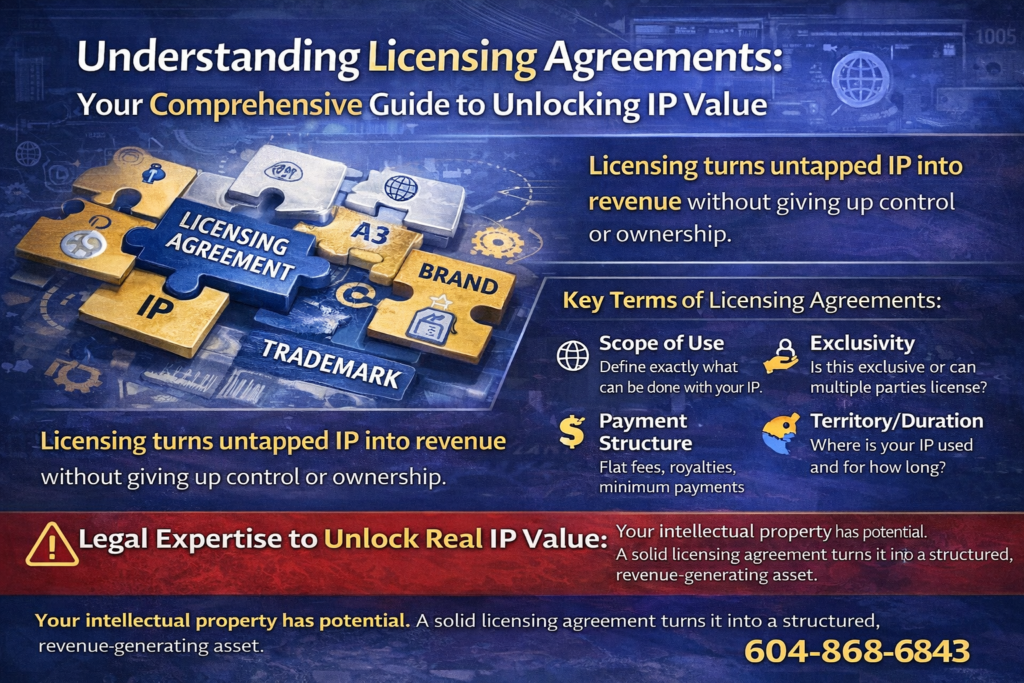
An idea sitting on a shelf is just an idea… until you license it. We see this all the time. A company builds something smart. A new software tool. A brand name people remember. A design that works beautifully. And then… it just sits there. Untapped. Underused.
Licensing is what turns that quiet asset into revenue. It allows others to use your intellectual property while you stay in control. When we do it the right way, it opens doors to income, builds strong partnerships, and creates long-term value… all without losing ownership. That is powerful.
Let’s understand.
What Is a Licensing Agreement?
A licensing agreement is a legal contract. It allows one party… the licensee… to use intellectual property owned by another party… the licensor. Intellectual property can include:
- Trademarks
- Copyrighted material
- Patents
- Trade secrets
- Software
- Brand names
Instead of selling the IP outright, the owner gives permission to use it under specific terms. In return, they receive payment. Sometimes that payment is a flat fee. Sometimes it is ongoing royalties. Sometimes both.
It sounds simple. But the details matter. A lot.
Why Businesses Choose to License
Here is the interesting part. Licensing is not just about money… although revenue is a big reason.
It is also about scale.
Let us say you developed a software tool. You do not have the resources to enter five international markets. A licensing deal allows a local partner to use your technology in those markets while you earn income from their sales. No extra offices. No hiring overseas teams.
According to the World Intellectual Property Organization, global IP-related industries account for a significant portion of GDP in many developed economies. That tells us one thing clearly… intellectual property is not just legal paperwork. It is economic fuel. Licensing also spreads risk. Instead of investing heavily in expansion yourself, you share the opportunity.
Key Terms That Actually Matter
Now here is where many people skim. A strong licensing agreement clearly defines:
Scope of use
What exactly can the licensee do with the IP? Where? For how long?
Exclusivity
Is the license exclusive… meaning only one party can use it? Or can multiple parties license the same asset?
Payment structure
Flat fees? Royalties based on revenue? Minimum guarantees?
Territory
Is the agreement limited to one country? A region? Global rights?
Duration and termination
When does the agreement end? What happens if one party breaches the contract?
Small wording differences here can create very big consequences later. We have all seen situations where vague language led to expensive disputes. And trust us… those are rarely pleasant.
Common Mistakes We See
Let us talk honestly. Some businesses rush licensing deals because they are excited. Others download templates online and assume they are protected. That is risky.
A poorly drafted agreement can lead to:
- Loss of control over your brand
- Revenue disputes
- Intellectual property misuse
- Regulatory issues in cross-border transactions
Studies in commercial litigation show that contract ambiguity is one of the leading causes of business disputes. It is not usually bad intent. It is unclear drafting.
And when IP is involved, the stakes are higher.
How Licensing Unlocks Real IP Value
Here is the part many overlook.
Intellectual property often does not appear as physical inventory. You cannot hold it. But on a balance sheet, it can be one of the most valuable assets a company owns. Licensing turns that intangible asset into measurable revenue streams. It also increases company valuation. Investors pay attention to predictable royalty income. Buyers do too. Instead of letting your IP sit unused, licensing gives it motion. And motion creates value.
The Role of Strategic Legal Guidance
Licensing agreements exist where legal rules, business planning, and risk control all come together. That balance requires careful structuring.
At Rock-Hurst Astor PLLC, we work with companies navigating complex commercial and technology agreements every day. From software licensing to cross-border corporate transactions, our focus is simple… protect your interests while positioning you for growth.
Licensing is not just paperwork. It is leverage. When we handle the details with care and stay aware of the risks, intellectual property stops sitting idle… it starts working as a reliable revenue stream.
Final Thoughts
An idea has potential. A properly structured licensing agreement unlocks it. Once we know exactly what the terms say, define the scope properly, and secure our ownership, licensing stops feeling like just a contract… it becomes a real business tool. It becomes strategy. It becomes expansion without overextension. It becomes income without surrender.
If your company owns intellectual property and you are considering licensing opportunities, do not treat it casually. The right structure today prevents problems tomorrow… and opens doors you may not even see yet.
At Rock-Hurst Astor PLLC, we help businesses turn intellectual assets into structured, protected value. If you are ready to explore how licensing can work for your organization, we would be glad to guide you through it… thoughtfully, clearly, and with your long-term goals in mind.