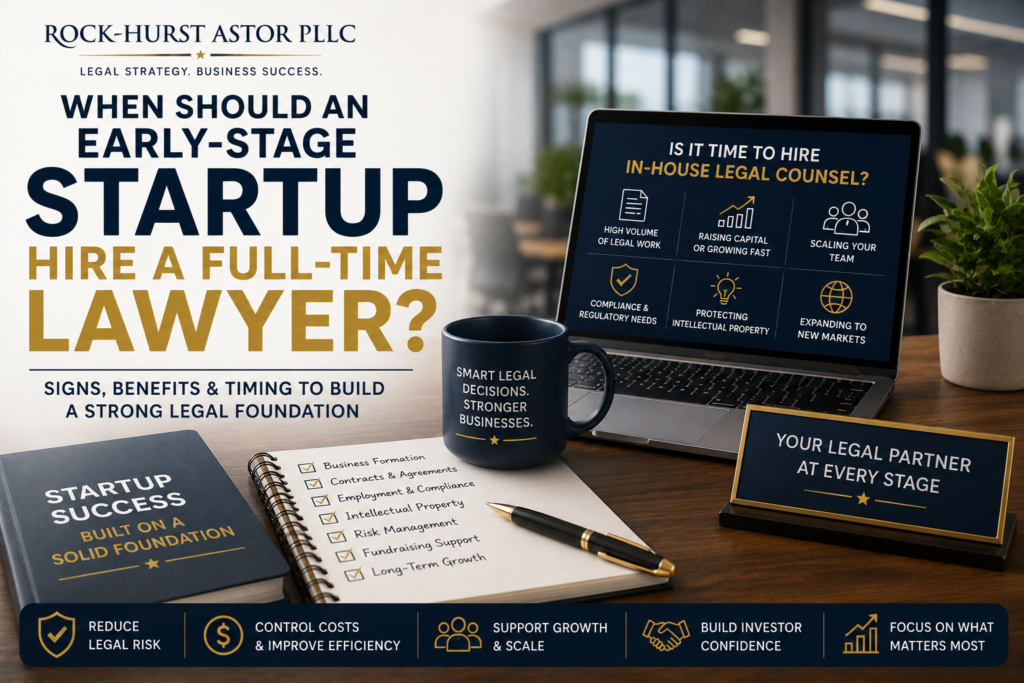
Launching a startup involves countless moving parts—building products, hiring employees, raising capital, and scaling operations. During the early stages, most startups rely on outside legal counsel for occasional guidance. But as the company grows, founders often begin asking an important question:
When should an early-stage startup hire a full-time lawyer?
Hiring in-house legal counsel is a major decision. While a full-time lawyer can provide valuable strategic support, bringing one on board too early can strain a startup’s budget. On the other hand, waiting too long may expose the company to unnecessary legal and operational risks.
In this guide, we’ll explore the signs that indicate it may be time for your startup to hire a full-time lawyer and how in-house legal counsel can support long-term growth.
What Does a Full-Time Startup Lawyer Do?
A full-time startup lawyer—often called in-house counsel—manages the company’s ongoing legal needs from within the organization.
Unlike outside law firms that handle specific tasks or projects, an in-house attorney works closely with founders, executives, and departments to provide day-to-day legal guidance.
Their responsibilities may include:
- Contract management
- Employment law compliance
- Intellectual property protection
- Fundraising and investor relations
- Regulatory compliance
- Risk management
- Dispute resolution
As startups scale, legal issues become more frequent and more complex. Having dedicated legal counsel can help the business move faster while reducing risk.
Why Most Startups Don’t Hire a Lawyer Immediately
In the earliest stages, most startups simply don’t need a full-time attorney.
Early-stage companies often rely on:
- Startup law firms
- Fractional legal counsel
- Flat-fee legal packages
- On-demand legal services
This approach is cost-effective because legal needs are still relatively limited.
Typical early-stage legal tasks include:
- Business formation
- Founder agreements
- Basic contracts
- Trademark filings
- Initial fundraising documents
Outsourcing these services is usually more affordable than paying a full-time salary.
Signs It May Be Time to Hire a Full-Time Lawyer
So when does hiring an in-house attorney start making sense?
Here are the most common indicators.
1. Your Startup Is Managing Constant Legal Work
One of the clearest signs is the volume of ongoing legal activity.
If your startup is regularly handling:
- Vendor agreements
- Customer contracts
- Employment matters
- Compliance reviews
- Investor negotiations
then relying entirely on outside counsel may become inefficient and expensive.
Frequent legal needs often justify having someone internally who understands the business in real time.
2. Legal Fees Are Becoming Too Expensive
Outside law firms can charge:
- $300 to $1,000+ per hour
As legal demands increase, monthly invoices can quickly become substantial.
Many startups realize they are spending:
- $20,000 to $50,000+ per month on outside counsel
At that point, hiring an in-house attorney may actually reduce long-term legal costs while improving response time and operational efficiency.
3. You’re Preparing for Major Fundraising
Fundraising creates significant legal complexity.
As startups pursue:
- Seed rounds
- Series A funding
- Venture capital investments
legal responsibilities increase dramatically.
This may involve:
- Investor negotiations
- Securities compliance
- Due diligence preparation
- Equity structuring
A full-time lawyer can help manage these processes more efficiently and ensure the company remains investor-ready.
4. Your Startup Is Hiring Rapidly
Growth-stage startups often experience rapid hiring.
This introduces legal issues related to:
- Employment contracts
- Employee classifications
- Workplace policies
- Equity compensation plans
- Labor law compliance
A dedicated legal professional helps ensure employment practices remain compliant as the company scales.
5. Your Company Operates in a Regulated Industry
Some industries involve heavy regulatory oversight.
Examples include:
- Fintech
- Healthcare
- Biotechnology
- Artificial intelligence
- Data privacy and cybersecurity
In regulated sectors, legal compliance becomes part of daily operations.
Hiring in-house counsel may become essential to help monitor legal obligations and reduce regulatory risk.
6. Intellectual Property Is Central to Your Business
For many startups, intellectual property (IP) is the company’s most valuable asset.
If your startup relies heavily on:
- Proprietary software
- Patents
- Trade secrets
- Licensing agreements
then ongoing legal oversight becomes increasingly important.
An in-house lawyer can help protect and manage intellectual property proactively.
7. The Company Is Expanding Internationally
Global expansion creates additional legal complexity.
This may involve:
- International contracts
- Foreign employment laws
- Data privacy regulations
- Cross-border tax and compliance issues
As startups enter new markets, having legal counsel integrated into the business can help navigate international risks more effectively.
Should Startups Hire a General Counsel or Use Outside Counsel?
There’s no one-size-fits-all answer.
Many startups use a hybrid approach:
- Outside law firms for specialized legal matters
- In-house counsel for day-to-day operations
This allows startups to balance:
- Cost efficiency
- Strategic legal support
- Specialized expertise
In many cases, startups first hire:
- Fractional general counsel
- Part-time legal advisors
before committing to a full-time attorney.
How Much Does a Full-Time Startup Lawyer Cost?
Hiring in-house counsel is a significant investment.
Typical salary ranges include:
- Junior startup counsel: $120,000 – $180,000/year
- Experienced in-house attorney: $200,000 – $350,000+/year
Additional costs may include:
- Benefits
- Equity compensation
- Bonuses
For startups with growing legal complexity, however, the investment often pays off through:
- Faster legal turnaround
- Reduced outside legal fees
- Better risk management
Benefits of Hiring a Full-Time Startup Lawyer
A dedicated startup lawyer provides several advantages.
Faster Decision-Making
Legal questions can be resolved quickly without waiting on outside firms.
Better Understanding of the Business
An in-house attorney gains deep knowledge of the company’s goals, operations, and culture.
Reduced Long-Term Risk
Proactive legal oversight helps prevent disputes and compliance issues.
Improved Investor Confidence
Strong legal infrastructure demonstrates professionalism and maturity to investors.
Cost Control
For startups with frequent legal work, in-house counsel may lower overall legal spending.
When Is It Too Early to Hire a Full-Time Lawyer?
Hiring too early can strain cash flow unnecessarily.
Most startups should avoid full-time legal hires if:
- Legal work is still occasional
- Revenue is limited
- Outside counsel can handle needs efficiently
- The business is pre-funding or pre-product-market fit
In these cases, outsourced legal support is usually the smarter option.
Why Legal Strategy Matters for Startups
Legal issues can affect nearly every aspect of a startup’s success:
- Fundraising
- Hiring
- Product development
- Intellectual property
- Compliance
- Partnerships
The right legal strategy helps startups grow with confidence while avoiding unnecessary risk.
Why Choose Rock-Hurst Astor PLLC?
Rock-Hurst Astor PLLC helps startups navigate every stage of growth—from formation to scaling operations.
The firm provides:
- Startup legal guidance
- Contract drafting and negotiation
- Fundraising support
- Intellectual property protection
- Compliance and risk management
- Strategic outside counsel services
Whether your startup is considering outside counsel or evaluating when to hire in-house legal support, experienced guidance can help you make the right decision.
Final Thoughts
So, when should an early-stage startup hire a full-time lawyer?
The answer depends on your company’s:
- Legal workload
- Growth stage
- Industry complexity
- Fundraising activity
- Hiring pace
For many startups, the right time comes when legal issues become a daily operational concern rather than an occasional project.
Until then, working with experienced startup counsel can provide the flexibility and protection needed to build a strong legal foundation for future growth.