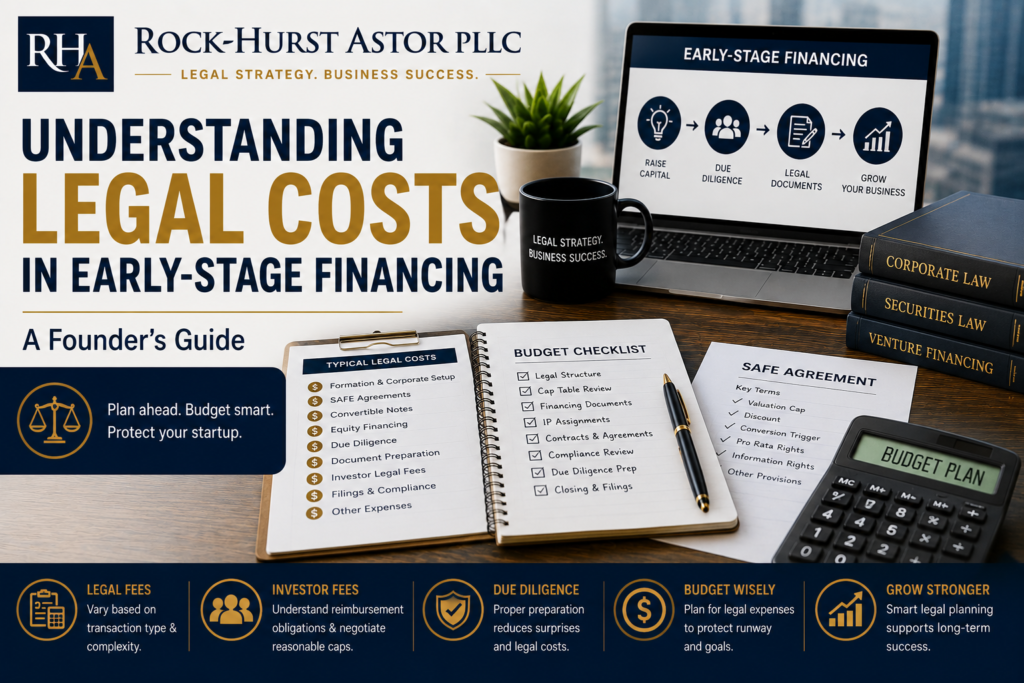
For an early-stage startup, raising capital can be a major milestone. Funding can help founders build products, hire employees, acquire customers, and move toward profitability. However, securing investment involves more than convincing investors to write a check. It also creates legal expenses that founders need to understand before beginning the financing process.
Legal costs can vary substantially depending on the type of financing, the number of investors, the company’s structure, and the complexity of the transaction. For a founder operating with limited cash and a short runway, failing to budget for these expenses can create unnecessary financial pressure.
Understanding where legal costs come from—and how to manage them—can help founders approach fundraising with greater confidence.
What Is Early-Stage Financing?
Early-stage financing generally refers to capital raised during the initial stages of a startup’s development. Depending on the company, this may include:
- Pre-seed funding
- Seed financing
- Angel investment
- SAFE agreements
- Convertible notes
- Friends-and-family funding
- Early venture capital investment
Each financing method can have different legal requirements and costs.
A relatively simple SAFE financing may require less legal work than a priced equity round involving multiple institutional investors, extensive due diligence, preferred stock, board rights, and detailed closing documents.
Why Do Startups Have Legal Costs During Fundraising?
Legal expenses arise because financing transactions involve important legal and financial rights.
A startup attorney may help with:
- Reviewing the company’s corporate structure
- Preparing financing documents
- Reviewing term sheets
- Negotiating investor terms
- Conducting due diligence
- Addressing securities law requirements
- Updating corporate records
- Preparing board and shareholder approvals
- Reviewing intellectual property ownership
- Closing the transaction
The attorney’s role is not simply to prepare paperwork. Legal counsel can help founders understand what they are agreeing to and how the financing could affect ownership and control.
Common Legal Costs in Early-Stage Financing
There is no universal price for startup financing legal work. Costs depend heavily on the transaction.
As a general budgeting framework, founders may encounter expenses such as:
| Legal Work | Potential Cost Range |
|---|---|
| Basic startup formation | $1,000–$3,000+ |
| SAFE or convertible note financing | $2,000–$10,000+ |
| Simple seed financing | $5,000–$15,000+ |
| More complex institutional financing | $15,000–$50,000+ |
| Investor legal fee reimbursement | Varies by transaction |
| Corporate cleanup before financing | Depends on issues identified |
These figures are illustrative budgeting ranges rather than fixed market rates. Actual fees can be significantly different depending on the lawyer, location, financing structure, number of investors, negotiations, and condition of the startup’s existing legal records.
Founders should request a clear scope of work and fee estimate before beginning a financing project.
SAFE Agreements and Legal Costs
A SAFE, or Simple Agreement for Future Equity, is commonly used by early-stage startups seeking capital before a priced equity round.
Compared with a complex preferred stock financing, a straightforward SAFE round can be relatively efficient from a legal perspective.
However, founders should still understand important terms such as:
- Valuation caps
- Discounts
- Conversion mechanics
- Pro rata rights
- Investor rights
- Triggering events
A seemingly simple financing can become more complicated when multiple SAFEs contain different terms.
Legal counsel can help founders understand how today’s agreements could affect future ownership and dilution.
Convertible Notes and Legal Expenses
Convertible notes are another common early-stage financing instrument.
Unlike a SAFE, a convertible note generally functions as debt that may convert into equity later.
Legal documents may address:
- Principal amount
- Interest
- Maturity date
- Valuation cap
- Discount rate
- Conversion events
- Default provisions
If several investors participate under different terms, legal work can become more complicated.
Founders should consider not only the immediate legal fee but also the long-term consequences of the financing structure.
Priced Equity Rounds Can Cost More
As startups mature, they may raise capital through a priced equity financing.
This can involve issuing preferred stock to investors and negotiating a much broader set of rights.
Legal work may include:
- Term sheet negotiation
- Stock purchase agreements
- Amended charter documents
- Investor rights agreements
- Voting agreements
- Right of first refusal agreements
- Board documentation
- Disclosure schedules
- Legal opinions
- Closing documents
Because the transaction is more comprehensive, legal costs can be substantially higher than those associated with a simple early-stage financing instrument.
Investor Legal Fees Can Be Another Expense
Founders sometimes assume their company’s legal bill is the only legal expense involved in fundraising. That isn’t always the case.
Some investors—particularly institutional investors—may require the startup to reimburse some or all of the investor’s legal expenses, often subject to a negotiated cap.
This issue should be addressed early.
Before agreeing to financing terms, founders should understand:
- Whether investor legal fees must be reimbursed
- Whether there is a maximum reimbursement amount
- Which legal expenses are covered
- Whether reimbursement is conditional on closing
Negotiating a reasonable cap can help prevent unexpected expenses.
Due Diligence Can Increase Legal Costs
Investors commonly perform due diligence before completing an investment.
They may request information concerning:
- Corporate formation
- Ownership
- Cap tables
- Previous financing
- Intellectual property
- Employee agreements
- Contractor arrangements
- Customer contracts
- Vendor agreements
- Litigation
- Regulatory compliance
If records are incomplete or inconsistent, attorneys may need additional time to correct the problems.
For this reason, legal preparation before fundraising can save money later.
Corporate Cleanup Before Fundraising
Some startups discover legal problems only when an investor begins due diligence.
Examples include:
- Missing founder agreements
- Incorrect cap tables
- Unrecorded stock issuances
- Incomplete IP assignments
- Outdated corporate records
- Poorly documented contractor relationships
- Missing board approvals
Correcting these issues can increase legal expenses and potentially delay the financing.
Founders should consider conducting a legal health check before approaching investors.
How Founders Can Manage Financing Legal Costs
Legal work is important, but startups still need to control expenses.
1. Start Preparing Early
Avoid waiting until an investor wants to close immediately. Early preparation gives your attorney enough time to identify problems before they become urgent.
2. Keep Corporate Records Organized
Maintain an accurate cap table and organized copies of corporate, employment, IP, and financing documents.
3. Establish a Clear Scope
Ask your lawyer what services are included in the engagement and which issues could result in additional fees.
4. Ask About Flat Fees
Some financing projects may be suitable for fixed-fee arrangements. Ask whether your attorney can provide predictable pricing for defined work.
5. Consolidate Questions
Prepare questions and documents before meetings. Efficient communication can reduce unnecessary billable time.
6. Budget for Unexpected Issues
Even a well-prepared financing can uncover unexpected legal matters. A contingency reserve can help protect your operating runway.
Don’t Choose Legal Counsel Based Only on Price
The cheapest lawyer is not necessarily the most cost-effective option.
An attorney with startup and financing experience may identify issues earlier, negotiate more effectively, and help prevent expensive mistakes.
When evaluating legal counsel, founders should consider:
- Startup financing experience
- Understanding of venture capital transactions
- Communication style
- Fee structure
- Availability
- Experience with similar companies
- Ability to support future growth
The goal should be to find counsel that provides value, not simply the lowest hourly rate.
How Rock-Hurst Astor PLLC Helps Startups
Rock-Hurst Astor PLLC works with entrepreneurs and businesses on legal matters that arise during formation, growth, financing, and strategic transactions.
Startup legal support may include:
- Business formation
- Founder agreements
- SAFE agreements
- Convertible notes
- Venture capital financing
- Term sheet review
- Corporate governance
- Investor due diligence
- Commercial contracts
- Intellectual property matters
- Outside general counsel services
Experienced legal guidance can help founders understand financing terms, prepare for investor diligence, and address legal risks before they become costly obstacles.
Final Thoughts
Early-stage financing can provide the capital a startup needs to grow, but founders should budget for more than the amount they plan to raise. Legal fees, investor counsel reimbursement, due diligence, corporate cleanup, and transaction expenses can all affect the true cost of fundraising.
The best approach is to plan ahead. Review your company’s legal records before approaching investors, understand the financing structure, ask questions about attorney fees, and negotiate expense caps when appropriate.
Most importantly, founders should view legal counsel as an investment in the company’s future. The right attorney can help protect ownership, reduce risk, improve transaction efficiency, and ensure that the financing supports—not undermines—the startup’s long-term goals.